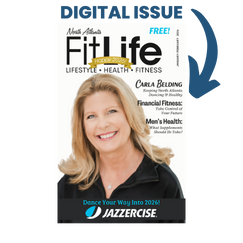
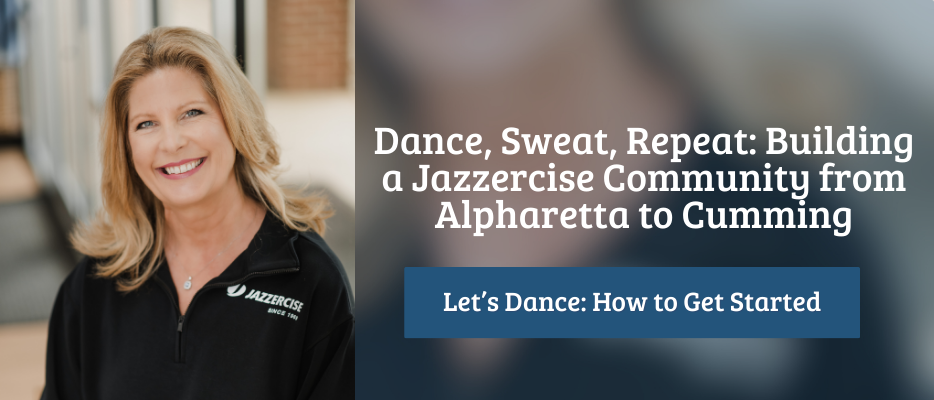
When you meet Carla Belding, you instantly feel her energy. The longtime Jazzercise instructor, business owner, and self-described “numbers girl with rhythm” radiates positivity and drive. Now, she’s bringing that same spirit to a brand-new Jazzercise location in Cumming, expanding the reach of her beloved Jazzercise Alpharetta community.
A Numbers Girl With Rhythm
“I’m an accountant. Jazzercise lets me use my business skills along with my creative side of marketing and dance.”
That perfect balance of structure and spontaneity has been the foundation of her success. Behind the choreography and music is a well-run business built on passion, consistency, and connection.
Inspiration & Guidance
“I rely heavily on my faith. When things get hard, I find myself praying for the right thing to do in life and in my business. I’ve always had a passion for helping others, and Jazzercise allows me to help people in their health and wellness. I want to leave a positive impact on people’s lives.”
Her circle of support runs deep. “There have been many people in my life who have pushed me to do things I didn’t think I could do. They range from teachers, family, and friends. But I couldn’t do any of this without the support of my husband. Being a Jazzercise husband is not easy,” she laughs. “At any given moment, I’m asking him to repair something, install something, or help me with an event.”
That humor and gratitude define her leadership style. “I’ve never walked away from a challenge, and the fitness industry is a challenge every day. I want people to remember that their health is the best investment they will ever make. Don’t stop moving. Find the time.”
Words to Live By
“Health is your greatest wealth.”
For Carla, this is more than motivation — it’s a mission. “Movement isn’t just about fitness or looking a certain way; it’s about creating a long, vibrant life filled with confidence, energy, and community,” she says. “Those words push me to invest in people because when someone feels strong, supported, and seen, their entire life improves. That’s the kind of impact I want my business to have every day.”
From Member to Mentor — to Multi-Studio Owner
“I started as a member in 1997 and became a certified instructor in 2002. I knew I wanted to do more than just teach — I wanted to use my skills and knowledge to operate a studio. I opened my first Jazzercise location in 2004 in Illinois and loved it!”
She purchased the Alpharetta location in 2020, and after years of growth and community success, she’s ready to expand again.
“I have recently acquired the Jazzercise location in Cumming, and I look forward to seeing this location grow over the next year. I’ll bring the same perspective that we have in Alpharetta — positive vibes and a strong community serving the women of North Forsyth.”
Positive Vibes Only!
Once known for its neon leotards and ‘80s energy, Jazzercise has evolved into a modern, full-body workout that combines dance cardio, strength training, HIIT, Pilates, and yoga. It’s attracting a new generation of participants — including Millennials and Gen Z — who crave workouts that are not only effective but also fun and community-driven.
“This is our happy place. From the moment you walk through the doors, you’ll feel a positive, warm vibe. We want our members to leave everything at the door and have one hour just for them. No outside noise — just positive vibes only.”
She adds, “If you’re moving to a new area and don’t know anyone, go to a Jazzercise class. You’ll make new friends! I know this to be true — my husband and I have moved five times, and I’ve found Jazzercise friends everywhere. They’re the BEST!”
Let’s Dance: How to Get Started
The Jazzercise New Year Sale is going on now! Get two months of unlimited classes for just $99 — but don’t wait, this sale ends January 31.
Monthly memberships are flexible to fit every schedule:
- $129 – Unlimited classes
- $119 – 12 classes per month
- $109 – 8 classes per month
- $99 – 4 classes per month
No long-term contracts, and there’s always room on the dance floor — no waitlists.
Need flexibility? Try a class pack:
- 8 classes – $219 (two-month expiration)
- 4 classes – $114 (one-month expiration)
Find Your Happy Place
With her infectious enthusiasm and commitment to faith, fitness, and fun, Carla Belding continues to make Jazzercise more than just a workout — it’s a celebration of strength, community, and joy.
Start 2026 off right by joining Jazzercise Alpharetta or the brand-new Jazzercise Cumming studio and discover how movement, music, and positivity can transform not just your body, but your entire outlook.